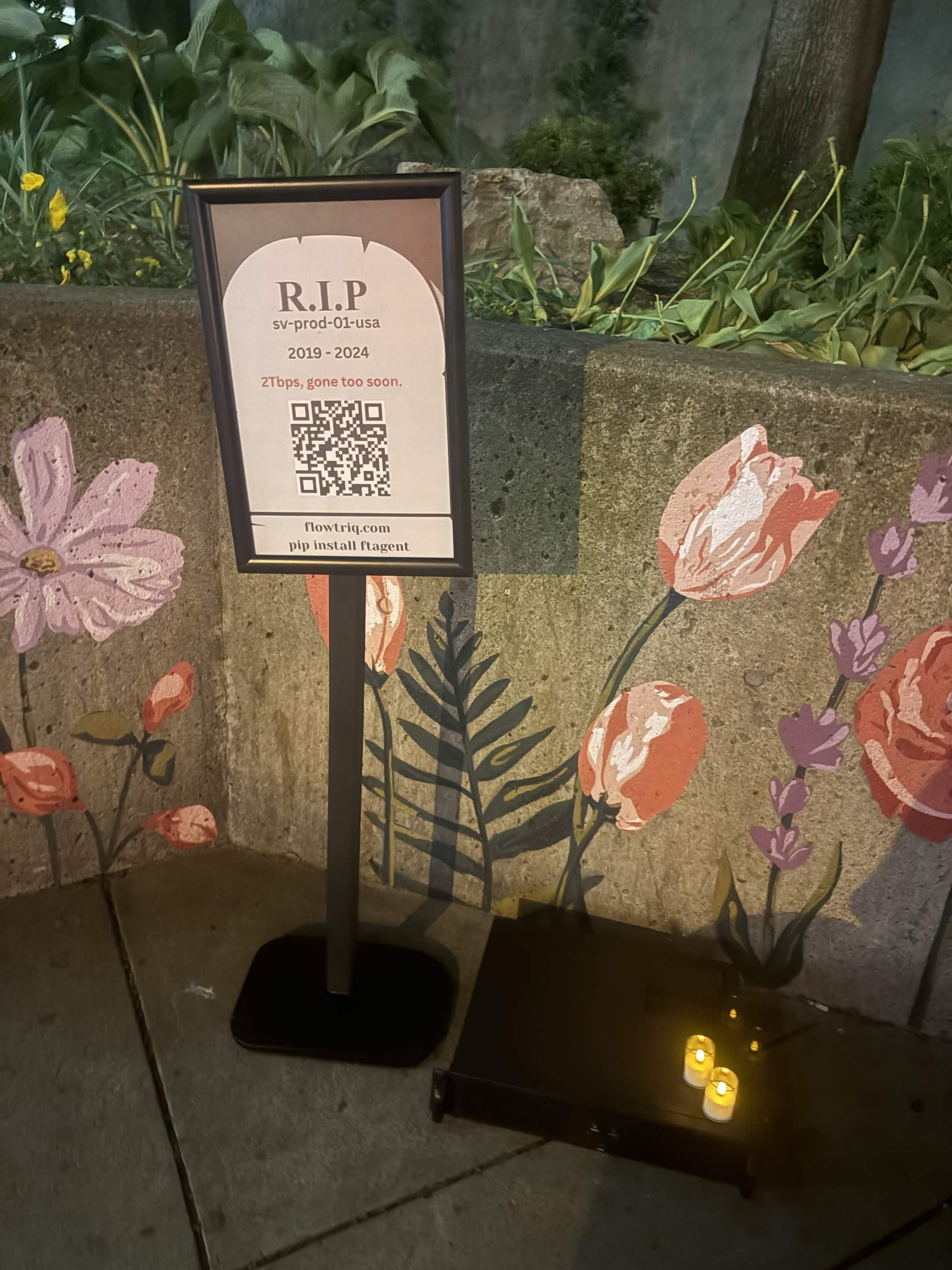
During Toronto Tech Week, we placed a server tombstone on the sidewalk outside 151 Front Street West. A sign on a stand, a gutted 2U chassis, battery candles. R.I.P. sv-prod-01-usa, 2019-2024, 2 Tbps gone too soon.
We didn't pick the spot randomly. If you're going to put a memorial for a dead server somewhere in Canada, 151 Front is the only address that makes sense.
What is 151 Front Street West?
151 Front Street West is Canada's largest carrier hotel. A carrier hotel is a building where telecommunications companies, internet service providers, cloud providers, and enterprises physically interconnect their networks. Cables come in from the street, run through riser shafts, and terminate in meet-me rooms where different networks plug into each other.
151 Front is where that happens at scale for most of Canada.
Who's inside
TORIX (the Toronto Internet Exchange) operates out of 151 Front. TORIX is the largest internet exchange point in Canada, where ISPs, content delivery networks, cloud providers, and enterprise networks peer with each other directly instead of routing traffic through paid transit. If you're a Canadian ISP and you want to exchange traffic with other Canadian networks without paying a transit provider to carry it, TORIX is where you do it.
Cologix TOR1 is one of the major data center operators in the building. Cologix runs carrier-neutral colocation across multiple floors, meaning any network can show up and cross-connect with any other network without requiring a business relationship with the building operator. This neutrality is what makes the building valuable.
Equinix has presence in the building as well. Equinix is the world's largest data center and colocation provider, and their Toronto footprint connects into the same meet-me rooms and cross-connect fabric.
Digital Realty rounds out the major operators. Along with dozens of smaller ISPs, transit providers, content networks, and enterprise customers who maintain cabinets or cages in the facility.
Why it matters for Canadian internet
When a user in Toronto loads a website hosted in Montreal, that traffic often passes through 151 Front. When a Canadian ISP peers with a content delivery network to serve video traffic locally instead of pulling it from the US, that peering session is probably established at TORIX inside 151 Front. When a Canadian enterprise connects to AWS or Azure or Google Cloud through a direct peering arrangement, the physical handoff frequently happens in this building.
The building sits at a geographic and network topology sweet spot. Toronto is Canada's largest city and the hub of its financial sector. The building itself is downtown, accessible, and has the power and fiber infrastructure to support dense interconnection. Over decades, this has created a gravity effect: the more networks that show up, the more valuable it becomes for the next network to show up too.
The result is that a disproportionate share of Canadian internet traffic touches 151 Front at some point in its path.
Why put a server tombstone there
Because the people who walk past 151 Front Street West every day are exactly the people who've been woken up at 3 AM by a DDoS attack.
Network engineers. NOC operators. Infrastructure managers at ISPs and hosting providers. The people who manage the routers, configure the BGP sessions, and respond when traffic spikes from normal to catastrophic in under a second. They work in this building. They commute past it. They grab coffee across the street from it.
A dead server with a tombstone and candles on the sidewalk is funny to normal pedestrians. To the people walking in and out of 151 Front, it's a war story they've lived. They know what "2 Tbps, gone too soon" means because they've seen what a volumetric flood does to production infrastructure.
That's who we built Flowtriq for.
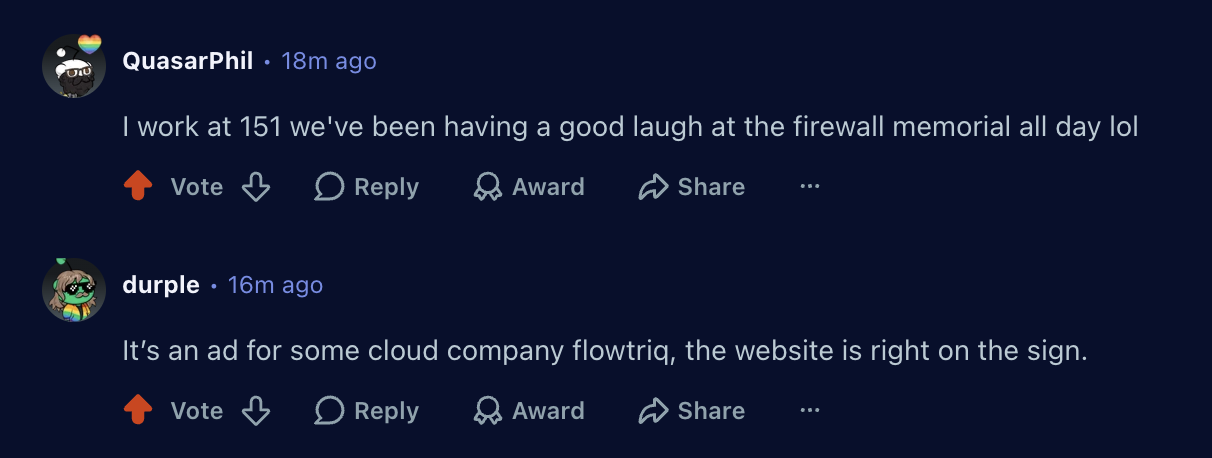
It worked. Someone posted the tombstone to Reddit. The replies included people who actually work in the building. "I work at 151 we've been having a good laugh at the firewall memorial all day lol." That's the audience. That's the reaction.
The DDoS problem at the peering edge
Carrier hotels like 151 Front are where DDoS attacks become someone's problem. When a flood enters a network at the peering edge, the operator has seconds to decide: absorb it, blackhole it, or scrub it. The tools available for that decision matter.
Most network operators at facilities like 151 Front run some combination of flow-based monitoring (sFlow or NetFlow from their border routers), manual threshold alerting, and reactive BGP blackholing. Some run FastNetMon. Some run Wanguard. Some have built internal scripts that parse flow data and trigger RTBH announcements.
What most of them don't have is sub-second detection with automatic classification, dynamic per-IP baselines, or a dashboard their whole team can use without SSH access to a monitoring server.
That's what Flowtriq does. Whether you're running an agent on each server, ingesting flow data from your border routers, or capturing mirrored traffic from a SPAN port, the detection and response pipeline is the same: detect in under one second, classify the attack type, alert your team, and auto-apply mitigation rules.
Try it
If you operate infrastructure at 151 Front, or anywhere else Canadian traffic flows through, Flowtriq is built for you.
curl -sSL https://flowtriq.com/install.sh | sudo bash
$9.99/node/month for agents. Flow sources from $19/source. Mirror/SPAN mode from $49/source. 14-day free trial, no credit card.